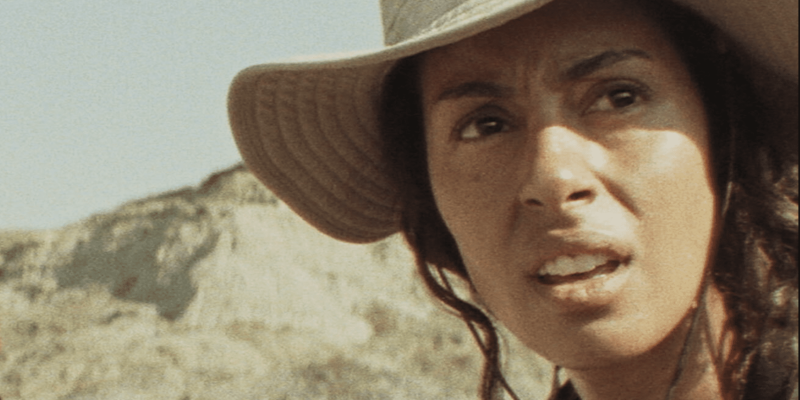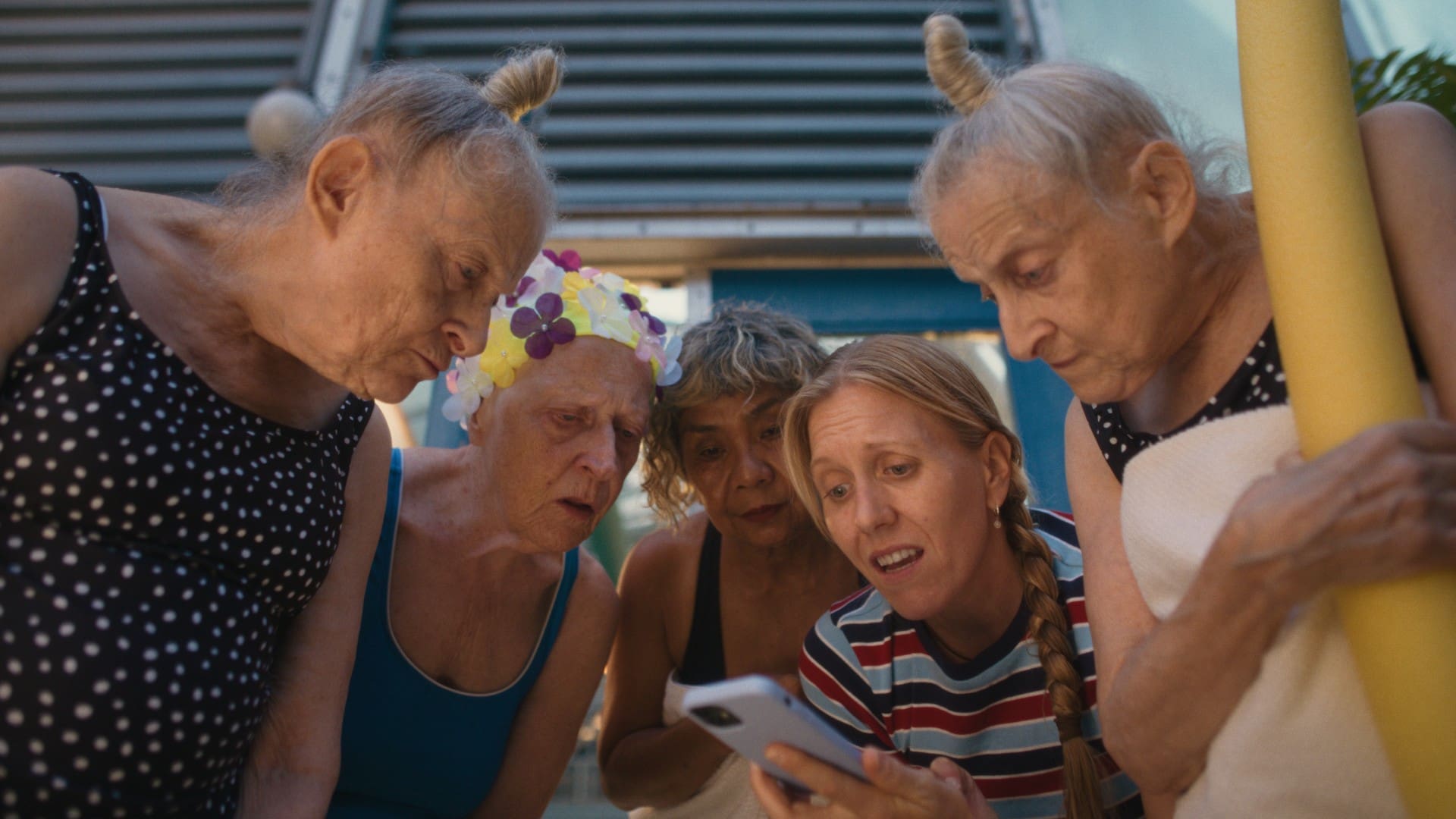
Under the 2026 Not Short on Talent cohort, Bare is headed to Cannes, where festival-goers can expose themselves to this bold and witty comedy short by Miranda MacDougall and Lucy McNulty and written by Claire Johnstone. Johnstone also plays the lead role of Daphnée, an aquafit instructor who, when it comes to modern dating, is barely treading water, specifically hung up on the task of taking a nude selfie. After speaking nakedly about the subject in the pool changeroom with the senior ladies of her course, she gains confidence, and it’s these scenes, in the changeroom, where Bare undresses expectations of on-screen nudity to show us how bodies really look — how aging bodies really look — and thus this already funny short about modern dating becomes also a thoughtful look at self-love and sustaining that confidence even late in life.
Writer Johnstone came to the idea from a number of angles. “The inspiration behind the story came from a mix of personal experience about love and dating, frustration at the lack of interesting acting opportunities, and our society’s obsession over delaying the process of aging at all cost,” she shares.
To that second point, Kathryn Shaw, an actor who plays Dolores, one of the seniors in Daphnée’s aquafit class, told Johnstone one day she was bored with the film and TV roles she was auditioning for, complaining that too often the gigs were for, stereotypically, “cookie-cutter” grandmothers — the kind who bake cookies. “I agreed with her,” Johnstone says. “I wrote [a role] for her and wanted to make sure the whole gang of aquafit ladies was as fun and interesting as the seniors in my life. I wanted them to be trendy, tech-savvy, and carefree, in contrast to younger Daphnée, who is awkward, clumsy, and insecure.”
Coincidentally, Johnstone was also in her second trimester of pregnancy at the time of production, so Daphnée’s character — “awkward, clumsy, and insecure” — was shaped and informed by a writer and actor already deeply conscious about her body. “The irony wasn’t lost on me that I was filming this movie in the moment where I needed it the most,” Johnstone says. “My body was changing and doing something incredible, yet I felt quite vulnerable. I was uncomfortable with the bathing suit scenes and on-camera nudity. I actually found myself asking more than once, out loud, ‘Who the heck wrote this script?!’”
Well, Claire Johnstone did — and when she brought it to director Lucy McNulty, who was eager to collaborate on something with friend and fellow filmmaker Miranda MacDougall, things began to go swimmingly.
“[The script] was celebratory without being corny or precious,” MacDougall says. “It was honest, frank, and juuuuust logistically ambitious enough to make us constantly question: ‘Can we do this for this much money in this little time…?’”
“There are so many films about dating and body image that can feel overly polished or self-serious, but Claire’s script had this beautiful awkwardness to it,” McNulty adds. “It understood that insecurity can be absurd and heartbreaking at the exact same time.”
Given much of the short takes place at the therapy pool (Vancouver’s Stan Stronge), Bare’s changeroom scenes more or less show the audience everything, but that’s the point; senior women are out there, too, and they take aquafit classes. At some point, they’re going to be naked. Get over it.
“We wanted it to feel completely un-self-conscious — rooted in body neutrality, unhurried and mundane,” MacDougall says. “To show bodies you genuinely don’t see on-screen very often, and to honour that without making a spectacle of it. That’s also part of what Daphnée is working through, so thematically it all felt very connected — we wanted the ease and comfort our ensemble had in their own nudity to directly juxtapose Daphnée’s hesitancy toward hers.”
McNulty, who mentions having a near-telepathic connection with her co-director, agrees. “I think one of the most radical things you can do on-screen is show bodies existing without apology. Especially female bodies. Especially aging female bodies,” she stresses. “Cinema has historically either erased older women entirely or flattened them into archetypes: the grandmother, the punchline, or a symbol of aging and decline. We wanted these women to feel sensual, funny, messy, bold, alive.”
After Bare, MacDougall and McNulty, both actors themselves, have plans to continue working together and develop features, including Deepfake — a psychological thriller written by Ariel Bond, which MacDougall is set to direct and McNulty will produce. Their feature Hunting Matthew Nichols just opened to nearly 1,000 screens across Canada and the United States. Meanwhile, McNulty is developing a feature in Toronto, currently in production with MGM; MacDougall returns as a series regular in Season 14 of When Calls the Heart and has just launched Third Rodeo, under which she is currently developing a slate of documentary and narrative projects.
Bare is available to screen at the Short Film Corner Video Library during the festival.
Jake Howell is a Toronto-based writer and film programmer.